
Emerging markets: the train has left the station, but you can still catch it
Published on 08.05.2026 CEST
For many investors, emerging markets still carry an outdated reputation. They are often seen as highly cyclical economies that depend heavily on exports to the West, are vulnerable to political shocks, and struggle when the US dollar strengthens. But recent events suggest this picture no longer fully reflects reality.
Over the past year, emerging markets have faced two major global shocks: a sharp escalation in trade tensions and a major disruption to global energy markets. In the past, events like these would likely have caused severe underperformance across emerging economies. Instead, emerging-market equities and bonds have shown notable resilience and, in many cases, outperformed developed markets.
We believe this is not a temporary phenomenon. It reflects a deeper transformation that has been building for more than a decade.
Why this time may be different
Many emerging economies are structurally stronger today than they were in previous market cycles (periods of growth and decline in markets). Governments in several countries have improved fiscal discipline, central banks have become more credible in fighting inflation, and domestic financial markets have deepened.
At the same time, emerging economies have become less dependent on Western consumers. Trade between emerging markets has grown significantly, while domestic demand has become a much larger driver of economic growth.
This matters for investors because it changes the diversification case for emerging markets — an important element for many. In the past, emerging economies often moved in line with developed markets during periods of stress. Today, their growth drivers are becoming more independent.
This shift is also taking place at a time when investors are increasingly questioning the durability of US exceptionalism. As concentration in US markets has increased, many portfolios have become heavily dependent on a small number of companies and themes. Emerging markets may offer exposure to different sources of growth.
Another important change is the rise of the emerging-market middle class. Domestic consumers in countries such as China, Brazil, and Mexico are becoming more important to economic growth. In many areas, consumption is shifting towards higher-value services, experiences, and premium products.
Taken together, these developments suggest that emerging markets are becoming more resilient, more diversified, and potentially more attractive as long-term investments.
One asset class, many different stories
Emerging markets should not be treated as a single block. Different countries are benefiting from different economic and structural trends.
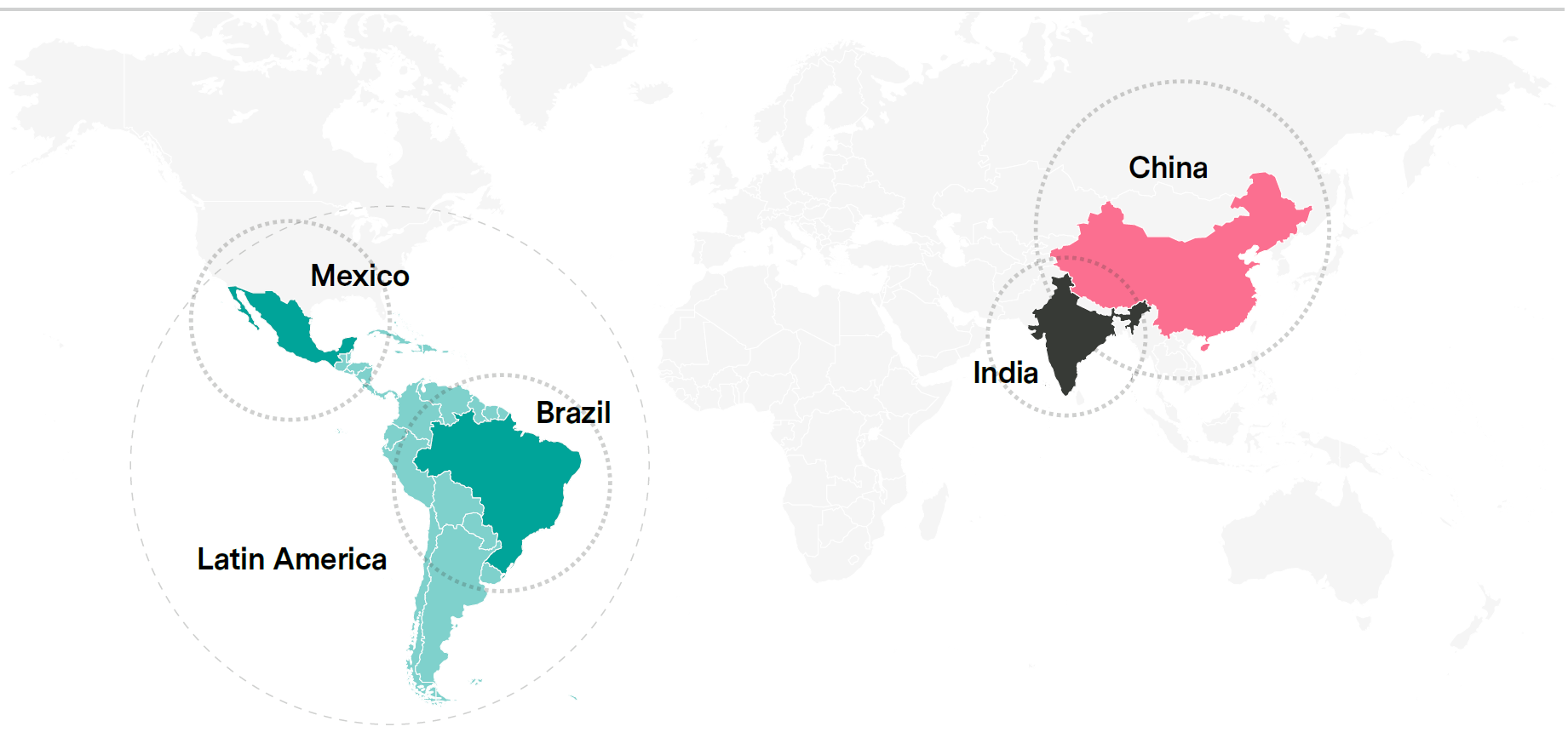
China remains in a complex transition period. Economic growth has been affected by deflationary pressures, reflecting subdued price growth and weak demand, and by weak overall consumer confidence. However, some parts of the economy are performing much better than others. Premium consumption, travel, outdoor activities, and experience-driven spending have remained relatively strong. China is also continuing to build its own AI and technology ecosystem.
India continues to offer strong long-term growth potential, although rising energy prices may create challenges in the near term. After a period of very high valuations, Indian equities have become more reasonably priced, but the market may still face pressure if higher oil prices affect profitability and consumer spending.
Latin America has emerged as one of the strongest-performing regions. Brazil, in particular, stands out due to lower valuations, falling interest rates, and its position as a commodity and energy exporter.
Mexico is also benefiting from near-shoring trends and its close trade relationship with the United States.
For investors, this means country selection and company selection are becoming increasingly important. The most attractive opportunities may come from identifying businesses that are positioned to benefit from long-term structural trends rather than simply buying broad market exposure.
Three powerful investment themes
We believe three major themes are reshaping the emerging-market investment universe.
Investment implications
We believe the most attractive opportunities today are concentrated in companies linked to structural growth themes rather than broad country exposure alone.
In Asia, we continue to favour companies connected to AI infrastructure and semiconductor supply chains, particularly in Taiwan and South Korea.
Brazil remains attractive because of supportive monetary policy, commodity exposure, and relatively low valuations.
Mexico also continues to benefit from near‑shoring, the relocation of production closer to the US market, and from resilient domestic demand.
India still offers compelling long-term potential, although near-term risks linked to higher energy prices may justify a more selective approach.
We also see opportunities in businesses linked to power infrastructure, electrification, and data-centre investment across selected emerging markets.
Smart component of a diversified portfolio
The broader message is simple: emerging markets are no longer just leveraged plays on global trade and commodity cycles. Many have become more resilient economies with stronger institutions, deeper domestic demand, and leadership positions in some of the world’s most important growth industries.
For long-term investors, this evolving backdrop may justify a reassessment of how emerging markets fit within diversified portfolios. Indeed, for many investors, the risk today may not be owning too much emerging-market exposure. It may be owning too little.
Please note: Emerging-market investments can be more volatile than developed-market equivalents and are exposed to a number of specific risks, including currency movements, political and regulatory change, lower liquidity, higher concentration, and variable standards of corporate governance and investor protection. Geopolitical tensions and sanctions can affect both the value of investments and access to them. The structural trends described above are long-term in nature and may be impacted by such events.
Published on 08.05.2026 CEST